
Goldenbet withdrawal limits and processing stages
 Available in US
Goldenbet’s general withdrawal terms combine a €20 minimum, published weekly and monthly ceilings, account-ownership rules and separate processing stages. A published general rule does not establish an available Australian casino cashout route; the Australian legal context is addressed separately.
Table of Contents
- The limits and turnover rules behind a cashout
- Why the receiving account has to match the player
- The records that distinguish a delay from a dispute
- Operator processing and external settlement take different time
- When the requested sum and received sum can differ
- Common questions
- A withdrawal figure only makes sense with its processing stage
The limits and turnover rules behind a cashout
Goldenbet’s general terms set a minimum withdrawal of €20 or its equivalent. The minimum is a contractual starting point, not a statement that any payment method can deliver every amount above it. A transaction can also encounter a provider’s own minimum, a currency conversion or a withdrawal ceiling. These are distinct constraints: the threshold for submitting a request is not necessarily the limit for receiving it in one transaction.
Goldenbet’s general withdrawal caps are €7,500 per week and €15,000 per month. The operator’s terms also allow maximums to depend on the selected payment method and permit instalment payments. A general ceiling therefore describes a general cap, while a particular transfer remains subject to the relevant route and account conditions. A weekly and a monthly maximum can both apply to the same account.
| Term | Figure | Practical meaning |
|---|---|---|
| Minimum withdrawal | €20 equivalent | The starting threshold in Goldenbet’s general terms |
| Weekly cap | €7,500 | General weekly withdrawal limit |
| Monthly cap | €15,000 | A further ceiling to consider alongside the weekly figure |
| Method-specific maximum | Depends on route | A selected bank, wallet or other method can impose its own ceiling |
Suppose an eligible balance were €8,000 and the stated general weekly cap applied. At most €7,500 would fit beneath that cap in the first week; the remaining €500 would need a later eligible period or an arrangement allowed by the actual terms. That arithmetic describes the effect of the published ceiling, not a promised payment schedule. Reaching a monthly ceiling would create a second constraint even if a subsequent week’s individual request were smaller than €7,500.
Goldenbet’s general terms also require at least one times the deposited funds in turnover before withdrawal. A €200 deposit would therefore face a €200 turnover requirement under that clause, independently of any withdrawal ceiling. Turnover measures qualifying wagers, not a guarantee that money remains after wagering. Game outcomes can reduce the available balance, and promotional funds can have separate conditions. The deposit-turnover clause should be kept distinct from a promotion’s wagering multiplier.
The wider payment-method catalogue explains why a listed bank, wallet or crypto asset can have different transfer characteristics. A general limit and an actual settlement instruction answer different questions, so a quoted cap should never be read as a promise that the entire amount will arrive in one payment.
Why the receiving account has to match the player
Goldenbet’s general terms restrict withdrawals to a payment account held by the account holder whose identity has been checked. Transfers to a third party are prohibited under those terms. The receiving account’s ownership is therefore separate from the requested amount and from the number of days an external transfer might take. Identity details, beneficiary details and the payment-provider account must correspond to the same person.
A mismatch can arise even where the account holder considers the recipient a convenient destination: a relative’s wallet, a shared bank account, an account under a former surname or a recently changed payment profile can all raise different ownership questions. Those are general examples, not claims that Goldenbet applies one particular document request to each situation. The important distinction is between proving identity and proving control of the account selected to receive funds.
- Identity
- Documents connecting the casino account to a named individual.
- Payment ownership
- Evidence that the intended bank, wallet or payment account belongs to the same account holder.
- Transaction trail
- Amounts, references and communications that distinguish a request from its subsequent processing and settlement.
- Account consistency
- Matching names and account details across the operator and receiving provider.
Goldenbet’s terms permit identity and payment-method checks, including supporting documentation and, in some circumstances, video verification. A pending check can hold up a cashout without changing the nominal withdrawal cap. For the document categories and the broader account policy, see the Goldenbet account-check overview.
Cryptocurrency adds an address to the receiving instruction, but the presence of an address does not remove account-ownership checks. Separately, moving funds on a blockchain can be irreversible once settled. An address error and an ownership-related hold are different problems with different records and remedies.
The records that distinguish a delay from a dispute
A withdrawal record becomes more useful when it shows a sequence of events rather than a single balance screenshot. A request timestamp, the amount and currency, the intended payout method, messages about document review and a later provider reference each identify a different stage. If the receiving bank or wallet records the transfer on a different date, that stage should be separated from the operator’s approval time.
For example, a request can be accepted into an operator’s queue, then paused for payment-ownership checks, then marked as processed before the external recipient sees funds. Those statuses describe different events; none, by itself, proves that the entire amount has reached the final account. An intermediary deduction may also leave the received amount smaller than the original request. Treating the whole sequence as a single ‘withdrawal time’ hides where the difference arose.
- Request evidence: amount, currency, request reference and the initial account status.
- Verification correspondence: which category of supporting document was requested and any acknowledgement received.
- Processing messages: the operator’s stated decision, payment reference and any reason given for an instalment.
- Receiving-side record: a bank or wallet transaction entry, settlement date and an itemised third-party charge where applicable.
When communicating with customer support, a clear chronology reduces confusion between identity review, the operator’s payment decision and the receiving provider’s work. Screenshots and correspondence can document what happened to a particular request; they cannot by themselves establish that the same experience applies to every other account. Keep sensitive identity documents and full payment credentials out of public complaint posts.
Goldenbet’s support channels include live chat around the clock and [email protected]. The separate license and Australian consumer-remedies information addresses the jurisdictional questions that become relevant when an operator and a customer cannot resolve a dispute. The available complaint route depends on the service and the authority involved, rather than on a generic promise attached to the word ‘licensed’.
Operator processing and external settlement take different time
Withdrawal processing is a sequence with separate stages. A pending stage can run for 0–72 hours, followed by an estimated one to five days for e-wallet and bank transfers. Goldenbet’s general terms describe bank transfers as processed within three banking days, excluding time taken by intermediaries. These durations cover different parts of the process and do not form a single guaranteed end-to-end payout time for Australian accounts.
| Stage | What happens | What affects elapsed time |
|---|---|---|
| Request submitted | An account records a requested amount and method | Request validity and applicable limits |
| Identity or payment review | Operator checks identity and recipient ownership when required | Document requests and review of the account |
| Operator pending and processing | Operator assesses and releases an eligible payout | Internal queue and stated processing terms |
| External settlement | Bank, e-wallet or network moves the funds onward | Provider schedules, intermediaries or blockchain confirmation |
| Final receipt | Receiving account reflects the credited transaction | Currency exchange and any external deductions |
A banking day differs from an ordinary calendar day. Weekends and local bank holidays can extend the calendar interval covered by a bank’s processing schedule. An external intermediary introduces another step even after an operator marks the transfer as processed. For a crypto transaction, a network’s confirmation and the receiving provider’s crediting rules form a different settlement chain.
Goldenbet’s general terms permit verification checks at any time and allow funds to be held while checks are outstanding. A theoretical timetable that leaves this stage out can therefore be misleading. A pending-stage estimate is best read as the scope stated by its publisher, not a clock that starts automatically for every payout and continues without interruption.
These figures describe Goldenbet’s wider account and payment conditions. They are not observations of a functioning Australian casino cashout service. The main practical distinction remains the point at which the operator has actually released a transfer and the separate time the receiving provider needs to complete it.
When the requested sum and received sum can differ
Withdrawal limits answer how much can be requested under a given rule; fees determine how much of an eligible amount is left when funds arrive. Routine operator deposit or withdrawal fees are not presented as the default. Goldenbet’s general terms nevertheless allow specific deductions and identify exceptional intermediary-bank charges of up to €16 or equivalent. Those rules address different circumstances, so a blanket ‘free withdrawal’ promise would hide the exceptions.
Consider an illustrative €100 bank payout with a €16 intermediary charge at the upper amount described in the general terms. If such a charge applied and no other costs arose, the recipient would see €84. This is a hypothetical subtraction based on the stated exceptional ceiling, not a fee charged on every transfer or a prediction about the operator’s decision on any account.
- Identify the requested amount and whether the general minimum and caps apply.
- Separate a casino-imposed deduction from a bank’s intermediary charge.
- Keep any exchange conversion distinct from a flat transfer charge.
- Compare the final receiving-account credit with the original request reference.
The general terms also address certain administrative deductions connected with account termination or verification-related circumstances. Those provisions are not ordinary per-withdrawal commissions and should be understood within the event that triggers them. A broad summary of routine banking fees cannot replace the exact applicable terms of the account or receiving provider.
For digital assets, a network charge can alter the quantity or value that reaches a wallet, while price movement changes the fiat equivalent even if the token quantity is unchanged. The homepage crypto-value calculator illustrates hypothetical value movement and user-entered network charges without treating them as a Goldenbet tariff.
Common questions
What is Goldenbet’s minimum withdrawal?
Goldenbet’s general terms state €20 or the equivalent, subject to the selected method and the other account conditions.
What general weekly and monthly withdrawal caps are listed?
The general caps are €7,500 per week and €15,000 per month. Method-specific maximums and instalment conditions can also apply.
Must the withdrawal account belong to the identity-checked account holder?
Yes. Goldenbet’s general terms require withdrawals to a payment account held by the identity-checked account holder and prohibit third-party transfers.
Does a published processing estimate guarantee a payout date?
No. Identity checks, operator processing and external bank or wallet settlement are separate stages, and the published durations describe different parts of that sequence.
A withdrawal figure only makes sense with its processing stage
Goldenbet’s published weekly and monthly ceilings, its contractual minimum and its one-times-deposit turnover rule govern different parts of a payout. Identity and payment-ownership checks can affect when an eligible request progresses, while a bank, e-wallet or blockchain network determines a separate portion of the journey.
The useful distinction is between the amount requested, the amount the operator releases and the amount the recipient finally receives. Published durations describe specific processing scopes; exceptional intermediary charges and changes in crypto value can create further differences without changing the original withdrawal request.
Recommend

Goldenbet slots, live tables and game providers
Goldenbet Field Notes Goldenbet’s wider casino catalogue covers thousands of titles, including video slots, feature-led...

Goldenbet payment methods and transfer costs
Goldenbet Field Notes Goldenbet's hybrid payment catalogue combines cryptocurrencies, payment cards, e-wallets and bank transfers....
Goldenbet's license and Australian online-casino rules
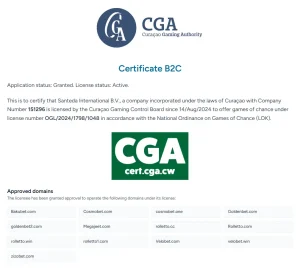
Goldenbet Field Notes Goldenbet has a domain-specific Curaçao certificate for goldenbet.com, while Australian law prohibits...

Goldenbet account checks, KYC and support
Goldenbet Field Notes Goldenbet operates a browser-based casino account with identity checks, payment-ownership rules, live-chat...