Real Money Casino Table Games in Australia: A Guide
 Available in AU
Understand how cards, roulette, poker, live tables and RNG games differ, alongside the limits of what can be confirmed about Australian play.
Table of Contents
- What Counts as a Casino Table Game?
- Online Play in Australia: The Legal Line and the Game Formats
- Bitcoin Table Games: What the Facts Can—and Can’t—Tell You
- Casino Table-Game Odds: What You Can Actually Verify
- How a Table Game Plays: Hands, Bets, and Outcomes
- Looking for a Casino Near You? Check What This Guide Can’t Confirm
- Live Tables and RNG Games Are Different Experiences
- Card Games: The Basic Table Setups
- Roulette Rules: What the Wheel Versions Change
- Poker at the Table: The Aim of the Hand
What Counts as a Casino Table Game?
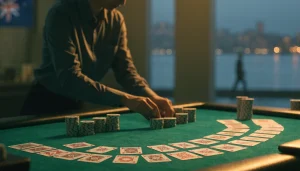
A casino table game is a game organised around a defined set of rules, a betting layout or playing surface, and an outcome that settles the bets. The word “table” is broader than a literal piece of furniture: online, the same kind of game can appear on a screen. What matters is the format of play, not whether you are leaning over felt or tapping a phone.
I used to treat table games as one big category, as if the only difference were the pictures on the screen. That misses the useful distinction: the game may be built around cards, a wheel, dice, or a dealer managing the action. Those formats can feel quite different even though they share the same basic idea of placing a wager on an outcome.
In a card-based game, cards shape what happens. The game may put your hand against a dealer’s, invite bets on different hands, or revolve around forming a poker hand. Those are still table games, but their rules and objectives are not interchangeable. “Card game” tells you the equipment; it does not tell you what you are trying to do.
When choosing a real-money casino for table games in Australia in 2026, you need clear details to assess what is known about each operator. Use these verdicts as a concise reference, and check the relevant terms before you play.
1. Uptown Pokies
License: Curacao (operating since 2017) · Min. deposit: A$20 Uptown Pokies has operated since 2017 under a Curacao licence, with a minimum deposit of A$20. You can use those details as a starting point when considering the operator.
2. GoldenCrown
License: Curacao Gaming Control Board OGL/2023/176/0095 (Hollycorn N.V.) GoldenCrown is listed with a Curacao Gaming Control Board licence, OGL/2023/176/0095, held by Hollycorn N.V. You can refer to the licence details when assessing the operator.
3. DragonSlots Casino
License: Curacao Gaming Authority (Jumpman Gaming Ltd) DragonSlots Casino is listed with a Curacao Gaming Authority licence associated with Jumpman Gaming Ltd. You can use this as the available licensing detail when reviewing the operator.
4. MrPacho
Payout speed: crypto 30-120 minutes, fiat 24-72 hours · Min. deposit: A$30 MrPacho lists crypto payouts at 30–120 minutes and fiat payouts at 24–72 hours; its minimum deposit is A$30. You can consider these payment details when deciding whether it suits your preferences.
5. Ricky Casino
Payout speed: crypto under 1 hour, PayID 1-3 business days · Min. deposit: A$20 (A$30 to qualify for the bonus) Ricky Casino lists crypto payouts in under an hour and PayID payouts in 1–3 business days. The minimum deposit is A$20, or A$30 to qualify for the bonus.
6. Lucky Dreams
License: Curacao · Min. deposit: A$20 (POLi) Lucky Dreams lists a Curacao licence and a minimum deposit of A$20 using POLi. You can use those details to guide your initial assessment.
7. Playfina Casino
License: Curacao eGaming (Hollycorn N.V., since 2017) · Min. deposit: A$20-30 (depends on the offer) Playfina Casino is listed with a Curacao eGaming licence held by Hollycorn N.V. since 2017. Its minimum deposit is A$20–30, depending on the offer.
8. JustCasino
License: Curacao Gaming Control Board JustCasino is listed with a Curacao Gaming Control Board licence. You can use that licensing information as the available reference point when reviewing the operator.
9. JeetCity Casino
License: Curacao eGaming (Dama N.V.) JeetCity Casino is listed with a Curacao eGaming licence held by Dama N.V. You can refer to this detail when assessing the operator.
10. Wild Tokyo
License: Curacao · Payout speed: crypto 30-60 minutes, fiat 1-5 days · Min. deposit: A$10 Wild Tokyo lists a Curacao licence, crypto payouts of 30–60 minutes, and fiat payouts of 1–5 days. Its minimum deposit is A$10.
A wheel game is another familiar format. In roulette, a ball’s landing place determines the result. Dice games instead centre on rolls and bets on their outcome. The physical objects differ, and so does the way a round resolves. That is the useful starting vocabulary—not a catalogue of titles.
Online, there are two broad ways the result can be produced. In a software-based version, a Random Number Generator determines matters such as which cards are dealt or where the roulette ball lands. In a live-dealer version, a real dealer uses real casino equipment, with the action streamed to players. Both present a table-game format, but one generates outcomes through software and the other shows a live game in progress.
That distinction also helps explain why table-game terminology can be slippery. A screen may show a felt layout and cards, yet the presentation alone does not tell you whether a dealer is physically handling them. Conversely, a live stream does not change the underlying category: it is still a table game if the play follows a table-game structure.
So when someone asks what table games a casino has, they may mean several things at once: card games, wheel games, dice games, or the delivery format used online. It is clearer to separate those questions. First identify the kind of game; then ask whether its outcomes come from software or from a live dealer. Less muddled already.
Pokies & Casino Games in Australia · Lightning Link Online Pokies in Australia: What’s Legal
Online Play in Australia: The Legal Line and the Game Formats
The legal line matters more than the look of a game page. Under Australia’s Interactive Gambling Act 2001, operators are prohibited from providing real-money online casino games to people in Australia. That includes online table games. Section 5 is part of the framework restricting Australian-based operators from offering these services to residents; the Act also prohibits overseas operators from providing them to customers physically located here.
I used to treat a polished table-game screen as a sign that the service behind it was legitimate and available to me. It isn’t. A familiar layout, a dealer on camera or a page that loads does not change the law. The Australian Communications and Media Authority (ACMA) enforces the rules and blocks unlicensed services. Access can be restricted, and a site appearing online is no proof that Australians may legally use it.
That distinction can get blurred in casual descriptions of international gambling sites. The fact that a company operates from overseas does not create an exception for real-money casino games offered to people in Australia. Nor does a foreign licence make the service lawful to provide here. The restrictions are directed at operators; the legal framework does not impose a fine or criminal prosecution on an individual simply for playing at an offshore casino. Still, that is no reason to treat blocked services as an approved route.
Two ways an online table can work
The legal position is separate from the technology. Online table games generally present outcomes in one of two broad formats: software-generated results or a live video stream of a dealer using real casino equipment. Neither format changes the Australian restriction on providing real-money casino games.
Legal Restriction
Under the Interactive Gambling Act 2001, operators are prohibited from providing real-money online casino games to people in Australia.
In an RNG game, software determines the result. For a card game, it determines which cards are dealt; in roulette, it determines where the ball lands. The screen may show a virtual table and animated cards or a wheel, but the displayed action is generated by the game software rather than captured from a physical table in real time.
A live-dealer game works differently on screen. A real dealer handles real casino equipment, and video of the table is streamed to viewers. The player sees a live scene rather than an entirely software-rendered table. That does not mean every part of the experience is automatically free from software: it describes the dealer and stream, not a blanket guarantee about how every system operates.
The difference is useful vocabulary when you encounter descriptions of online casino table games. “Live” refers to the streamed dealer and equipment; “RNG” refers to results determined by software. Neither label says anything about whether an Australian resident is permitted to access a real-money service. Marketing can make those formats sound like two doors into the same entertainment. Legally, the door is the issue.
Real money and free-to-play are not interchangeable
People also use “free” to mean different things: a demonstration mode, a game with no cash stake, or a promotion attached to an account. Those descriptions should not be treated as synonyms for a lawful real-money service. The law discussed here concerns interactive gambling services provided for real money, while a label on a screen alone may not tell you what conditions apply or how the game is structured.
Safe Online Pokies in Australia: Offshore Risks · 3-Reel Slots in Australia: RTP and Random Spins
So if you come across a table presented as free, check what the word means in context rather than assuming it settles the legal question. A no-stake demonstration is not the same thing as placing money on an outcome. And a promotional message does not turn a prohibited real-money service into an authorised one. I’ve learned not to let a friendly button or a “welcome” banner do the thinking for me.
There is also a practical difference between a game’s format and its availability. An RNG table can be described accurately as software-determined; a live table can be described accurately as streamed from a dealer. Those facts explain what a screen represents. They do not establish that the service may be supplied to someone in Australia, that a blocked site is accessible, or that an account can lawfully be used here.
When assessing what a page is actually offering, keep the questions separate: Is the outcome software-generated or streamed from a live table? Is real money involved? Is the service being provided to a person in Australia? The first is a technical distinction. The others bring the Australian legal boundary into view.
No format sidesteps it. A familiar virtual layout does not make a real-money game permissible, and a live camera feed does not make it a different legal category. The interface can change. The rule doesn’t.
Bitcoin Table Games: What the Facts Can—and Can’t—Tell You
“Bitcoin table game” sounds like a clear category, but it can blur two separate ideas: the game itself and the way money is handled. Blackjack, roulette or another table format is defined by its rules and how outcomes are produced. Bitcoin is a payment method. Putting the words together does not tell you whether a particular game accepts Bitcoin, has Bitcoin-only features or works differently from a conventional version.
Bitcoin is a payment method; it does not define the game’s rules, its format (RNG or live-dealer), or the availability of specific table games.
That distinction matters when comparing Bitcoin table games with other online table games. The useful starting point is the game format, not the currency named in a label. Online software can use a Random Number Generator (RNG) to decide which cards are dealt or where a roulette ball lands. In a live-dealer format, a real dealer uses casino equipment and the action is streamed to players. Those describe two ways an online game can present and determine play; neither description, on its own, says anything about Bitcoin support.
I used to treat a payment label like a feature list. It isn’t. A Bitcoin reference does not tell you what table games are available, how a hand is dealt, whether a roulette wheel is shown on video, or how a game’s rules are set out. It also does not establish that the experience is better, more private, faster or more reliable. Those would be separate claims, and the label alone cannot carry them.
The same caution applies to requests for the “best” Bitcoin table games or the best table games in a casino. There is no meaningful answer based only on the payment-method wording. A preference for watching a dealer and equipment on a live stream is different from preferring software-generated outcomes. Neither format becomes a Bitcoin-specific game simply because someone describes it that way. And without a substantiated comparison, a “top” label is just a sales pitch.
Real Cash Online Pokies in Australia: Bitcoin Guide · 5-Reel Slots in Australia: RTP, Bonuses and Play
The phrase can also be used loosely. It might refer to a table game someone hopes to pay for with Bitcoin, a game shown on a felt-covered table, or simply an online game discussed alongside cryptocurrency. Those meanings are not interchangeable. “Felt table” describes a surface; it does not establish a payment option or a special ruleset. A page using several of these phrases may still be describing the same ordinary game format.
If you are trying to understand what is actually being described, look for details about the play itself: whether outcomes are generated by software or shown through a live stream, and what the game’s rules say. Keep those questions separate from payment claims. If a description provides no clear answer, don’t fill the gap with an assumption.
There is an important Australian context, too. Real-money online casino games, including table games, are prohibited when offered to people in Australia under the Interactive Gambling Act 2001. A Bitcoin label does not change that legal position. Nor does it turn an online casino offer into a distinct, permitted kind of table game.
So the reliable distinction is modest: RNG and live-dealer formats explain how an online table game may produce or present its play. “Bitcoin” does not, by itself, explain either format or verify a game’s features. Keep the categories apart. Less guesswork.
Casino Table-Game Odds: What You Can Actually Verify
“Best odds” sounds like a simple label, but it can hide several different questions. You might mean the chance of winning a particular bet, the amount paid when it wins, or the share a game is expected to retain over time. Those are related, but they are not interchangeable. A game’s rules tell you how to play; they do not, by themselves, tell you its house edge.
Attention: A broad label such as “blackjack” or “roulette” is not enough to support a reliable comparison of house edges, as results depend on specific rules and payouts.
A house-edge chart needs more than a game name. It depends on the specific rules and payouts, and for some games, on the choices a player makes during play. A broad label such as “blackjack” or “roulette” is not enough to support a reliable comparison. Nor does calling a table game “low risk” explain which bet or rule set that description refers to.
That’s where I used to get caught: I’d see a confident ranking and treat it as a settled fact. It wasn’t a number I could apply to every version of the game. The details matter.
Odds are not the same as the aim of the game
The basic descriptions of table games explain what happens at the table: in blackjack, you compete with the dealer to get closer to 21; in baccarat, you can bet on either hand or a tie; poker is about building the strongest hand. Roulette uses a wheel, with different layouts available. These rules orient you. They do not show that one game has better odds than another.
Even a straightforward-sounding bet can’t be judged by its name alone. To compare its likelihood of winning with its payout, you need the actual terms of that bet. To compare a whole game, you also need to know which decisions are available and how the rules treat them. Without those details, a “best casino table games” list can sound precise while leaving out the conditions that make the comparison meaningful.
There is no defensible ranking of the best or worst table-game odds based only on these general descriptions. I can’t give you a reliable house-edge chart from them, and I wouldn’t trust one that presents a universal order without saying exactly which rules and bets it covers. That’s not a useful shortcut. It’s a missing explanation.
Mines Casino Game in Australia: Claims and Checks · Seven-reel slots in Australia: what to check
What a useful comparison would need
Before relying on an odds claim, look for a clear description of the particular game version, its payouts and the bet being assessed. If player decisions affect the calculation, the comparison should also state what assumptions it makes about those decisions. A headline saying “best odds” is not enough.
Keep the terms separate. A winning chance describes how often an outcome may occur; a payout describes what that winning outcome returns; a house edge is a long-run measure based on the game’s rules and bets. None of those promises what will happen in a particular session. Even a mathematically sound long-run figure is not a prediction of your next hand or spin.
So, when someone asks what casino table games have the best odds, the honest answer depends on the exact comparison they mean—and on information specific enough to calculate it. General rules alone can’t supply that. No magic chart.
How a Table Game Plays: Hands, Bets, and Outcomes
The useful way to learn how a table game works is to separate the action from the wager. First, identify what happens at the table; then notice what the player is being asked to bet on. Those are not always the same thing. A bet can concern your own hand, another hand, a tie, or the result of a dice roll. The wording sounds simple, but it is easy to skim past the part that tells you what your stake actually depends on.
Do
- Identify what action takes place at the table
- Notice what the player is asked to bet on
- Determine what outcome ends the bet
Don’t
- Treat a game’s target as a promise of a result
- Assume the layout tells you what the stake covers
- Blur different formats into a vague idea of “playing a hand”
In blackjack, the player is trying to finish with a hand value closer to 21 than the dealer’s. That gives you a clear comparison: your hand against the dealer’s. The practical point is not to treat the target as a promise of a particular result. The stated aim describes what the player is competing to do; it does not tell you how any individual hand will turn out. Keep the goal and the outcome separate. Simple distinction.
Other card-table formats can put the wager on different sides of a contest. A player may bet on their own hand, the Banker’s hand, or a tie. Before focusing on the cards, check which of those outcomes your wager is attached to. “Pick a side” sounds casual; what matters is understanding exactly which result would settle that bet. This is about reading the wager, not deciding that one choice is better.
A dice-table format has a different rhythm: players roll a pair of dice and bet on the outcome. Here the central action is the roll, and the wager concerns what happens from it. That is a different setup from comparing a player’s hand with a dealer’s. If you are learning the table, start by identifying the event that resolves the bet. Don’t assume a game’s name or its busy-looking layout tells you enough about what your stake covers.
Crash casino games in Australia: how they work
Poker is organised around building the best possible poker hand. That gives the play a hand-building objective rather than the dealer-versus-player comparison described in blackjack. The practical question is therefore what hand you are trying to make, not which side of a dealer contest your wager is on. This is the basic aim only; it does not define every poker format or explain a particular set of rules.
When I try to make sense of a table description, I look for three things: what action takes place, what the bet refers to, and what outcome ends that bet. It stops the different formats blending into one vague idea of “playing a hand.” A roll, a hand comparison and a hand-building contest are not interchangeable just because each has a table and a wager. That’s the useful starting point.
These are descriptions of game mechanics, not a recommendation to play. In Australia, the Interactive Gambling Act 2001 prohibits operators from providing real-money online casino games to people in the country. Knowing what a hand or wager means does not change that boundary. If you encounter a description, focus on understanding its terms rather than reading promotional language as a guarantee about the experience or result.
Looking for a Casino Near You? Check What This Guide Can’t Confirm
“Near me” is a location request. You want a place you can reach and a clear answer about whether it has table games. That is different from learning how an online table-game format works. A description of blackjack, roulette or poker does not tell you what is operating nearby, what a particular venue offers, or whether its information is current.
Verifying a Venue
- Check the venue’s physical address
- Confirm current table offerings directly with the venue
- Verify if the service is a real-money online offer prohibited in Australia
There is a more important distinction in Australia: online casino-style games for real money are prohibited when offered to people physically in the country. The Interactive Gambling Act 2001 bars operators from providing those services to Australian customers, and the Australian Communications and Media Authority enforces the rules, including blocking unlicensed domestic platforms. That restriction is about online services; it is not a directory of physical venues.
So don’t treat an online listing, a game page or a claim about a “new” table as proof that there is a nearby venue with that game. A location result and a game description answer different questions. For a physical place, details such as its address and current table offering need to be checked with the venue itself. I wouldn’t infer them from a general explanation of table games. Small distinction. Big one.
The wording people use can point in different directions, too. “Closest casino with table games” asks for distance and a venue; “casino table games near me” might mean someone wants to play locally, or simply wants to know what the games are like. The location part cannot be settled by explaining rules. And a page about online play should not be mistaken for permission to access a real-money online casino in Australia.
I’ve learned not to read a polished listing as a promise. “Available” can mean a game appears in a catalogue, not that a physical table is open at a particular venue. “New” can describe a newly added online title rather than a newly opened local casino. Those words need context before they mean anything useful to someone planning a visit.
Aristocrat Online Pokies in Australia: What to Know
If the question is about a physical location, use information tied to that venue and confirm its current details directly. If it is about online real-money casino games, remember that operators are prohibited from offering them to people in Australia. A location search does not change that legal line.
Live Tables and RNG Games Are Different Experiences
The word “live” can sound like a promise of a more authentic game. What it actually tells you is how the action is presented: a live-dealer game uses a real dealer and casino equipment, with video streamed to players. An online game run by software instead uses a random number generator to determine outcomes, such as the cards dealt or where the roulette ball lands.
That is the central difference. One format shows a real table through a video stream; the other produces its result through software. Neither label, by itself, tells you which option is more enjoyable or suitable. It only describes how the game’s action reaches you.
I used to treat a streamed table as though “live” meant the whole experience was automatically better. That was me reading too much into a label. A video stream changes what you see, but it does not change the basic distinction between watching a real dealer and receiving an outcome generated by an RNG. Different feel. Same need to understand the format.
What the stream tells you
With a live dealer, the dealer and equipment are real, and the video is broadcast to players. You are seeing the table’s action as a stream rather than watching software generate the cards or roulette result. That can make the format feel closer to a physical table, but the defining point is simply that the dealer and equipment are real and the action is streamed.
Live-Dealer
A real dealer uses real casino equipment, and the action is streamed to players via video.
RNG Games
Software determines the outcome, such as which cards are dealt or where the roulette ball lands.
The word “live” does not tell you what games are offered, how a particular table is run, or whether a site’s presentation is right for you. Those details depend on the specific service and cannot be inferred from the label alone. A polished stream is still a stream. No magic in the word.
What an RNG version does
In an RNG version, software determines the relevant outcome. For card play, it determines which cards are dealt; for roulette, it determines where the ball lands. You do not see a real dealer produce that outcome on a streamed table. The result comes from the generator instead.
That difference matters when you are comparing formats, not when trying to read a streak or guess what comes next. A video feed and a software-generated result are two different ways of presenting play; neither description makes the next result predictable.
When you come across a table game presented as “live” or software-based, check what the label refers to. Live means a real dealer and equipment shown over video. RNG means software determines the outcome. Keep those meanings separate, and the presentation is easier to understand.
Card Games: The Basic Table Setups
Card games at a casino table can share cards and betting, yet the central contest is different from one game to another. Blackjack puts you against the dealer. Baccarat gives you a choice of which hand to back, including a tie. Poker is about forming the strongest hand. That’s the basic map.
Online pokies in Australia: Bitcoin rules and risks
In blackjack, the player competes with the dealer, aiming for a hand value closer to 21. The comparison is between your hand and the dealer’s, rather than a contest to build a poker hand. I find that distinction useful: the number gives blackjack its target, while the opponent at the table gives the game its shape. No mystery there.
Baccarat centres on wagers placed before the result: you can back your hand, the Banker’s hand, or a tie. So the table’s basic decision is which outcome to support. The names can make it sound as if you are choosing a role or playing a hand yourself, but the core setup is simpler: your bet is attached to one of those outcomes. Baccarat is not blackjack with different labels; its table revolves around those available bets.
Poker has a different focus again. Players compete to build the best possible poker hand. That hand-building aim is what separates its setup from blackjack’s dealer comparison and baccarat’s choice of outcome. The word “best” can sound like a promise of a particular result; it means the goal of the contest, not a guarantee that any hand will win.
These categories help when the word “card game” feels too broad. Blackjack is defined here by competing against the dealer around a target value. Baccarat is described through the hands or tie a player may back. Poker centres on constructing a hand in competition. Same broad family, different table logic.
Card Game Setups
- Blackjack involves competing against the dealer to reach a target value.
- Baccarat focuses on backing a specific outcome: the player, the banker, or a tie.
- Poker centres on constructing the strongest possible hand in competition.
I used to lump card tables together because cards were the obvious thing they shared. That missed what matters when you’re trying to understand a game’s setup: who or what your wager is tied to, and what the contest is about. The distinction is plain once you separate those pieces. No ranking implied.
Roulette Rules: What the Wheel Versions Change
Roulette has several wheel versions, but the main names you will encounter are European, French and American. The clearest distinction between them is the numbered pockets: European and French wheels have 36 numbered pockets plus a green zero, while an American wheel has a green zero and a green double zero.
That extra pocket is easy to miss when you are focused on the betting layout. I used to treat the version name as decorative detail; it is not. Look at the wheel description, not just the table image. The pocket labels tell you which layout is being presented.
New Australian Online Pokies: What to Verify
European and French wheels
European and French roulette share the same stated pocket count: 36 numbers and a green 0. That makes the wheel’s number-pocket description straightforward to recognise. The version names are still distinct, though, so do not assume the labels mean every rule or table feature is identical. The shared count is what they have in common here.
If you are trying to understand casino table-game rules, start by separating the wheel from the betting area. The pocket count describes the wheel layout; it does not, by itself, explain every option shown on the table. A familiar-looking layout can make it tempting to skim. Better to check the version first.
The American wheel
American roulette has a green 0 and a green 00, alongside its numbered pockets. The double zero is the visible difference to remember when identifying this version. It is not the same pocket count as the European and French descriptions, so a quick glance at the wheel can save you from confusing the formats.
Dragon Link Online Pokies in Australia: What to Know
When comparing different casino table games, roulette is a case where one small visual detail changes the version you are looking at. The green pockets are the clue: one green zero for the European and French layouts, and a green zero plus a green double zero for the American layout. No guesswork needed.
That is the wheel distinction in a nutshell. It tells you which roulette format is on screen or shown in a rules panel, without making a claim about which version is preferable. Names matter. So do pockets.
Poker at the Table: The Aim of the Hand
The central idea in poker is to build the best possible hand. That is the aim players are working towards as they compete with one another. It sounds straightforward, but “best” is tied to the hand in front of you; it is not a promise that any particular player will come out ahead.
Bonus Buy Slots in Australia: How the Feature Works
I used to hear “battle it out” and picture a game where confidence did most of the work. It doesn’t change the basic objective. The hand is what matters. Poker is not simply about having a go at the dealer: the players are trying to assemble the strongest hand they can.
That gives you a useful way to read a description of a poker table game. Look for how it defines a hand and what counts as the best possible result. Those details explain how the objective is applied in that particular game. Without them, the broad aim is clear, but the full rules are not. Don’t fill that gap by assuming every poker table works the same way.
The phrase “best possible hand” can sound like a tidy finish line. In practice, it describes the goal, not a guaranteed outcome or a measure of how favourable a game is. Keeping those ideas separate helped me stop treating a simple description as a complete set of rules.
Poker, in short, is a contest to build the best hand. The exact way a table defines that hand belongs to its rules. Check the rules before treating the headline objective as the whole game.